


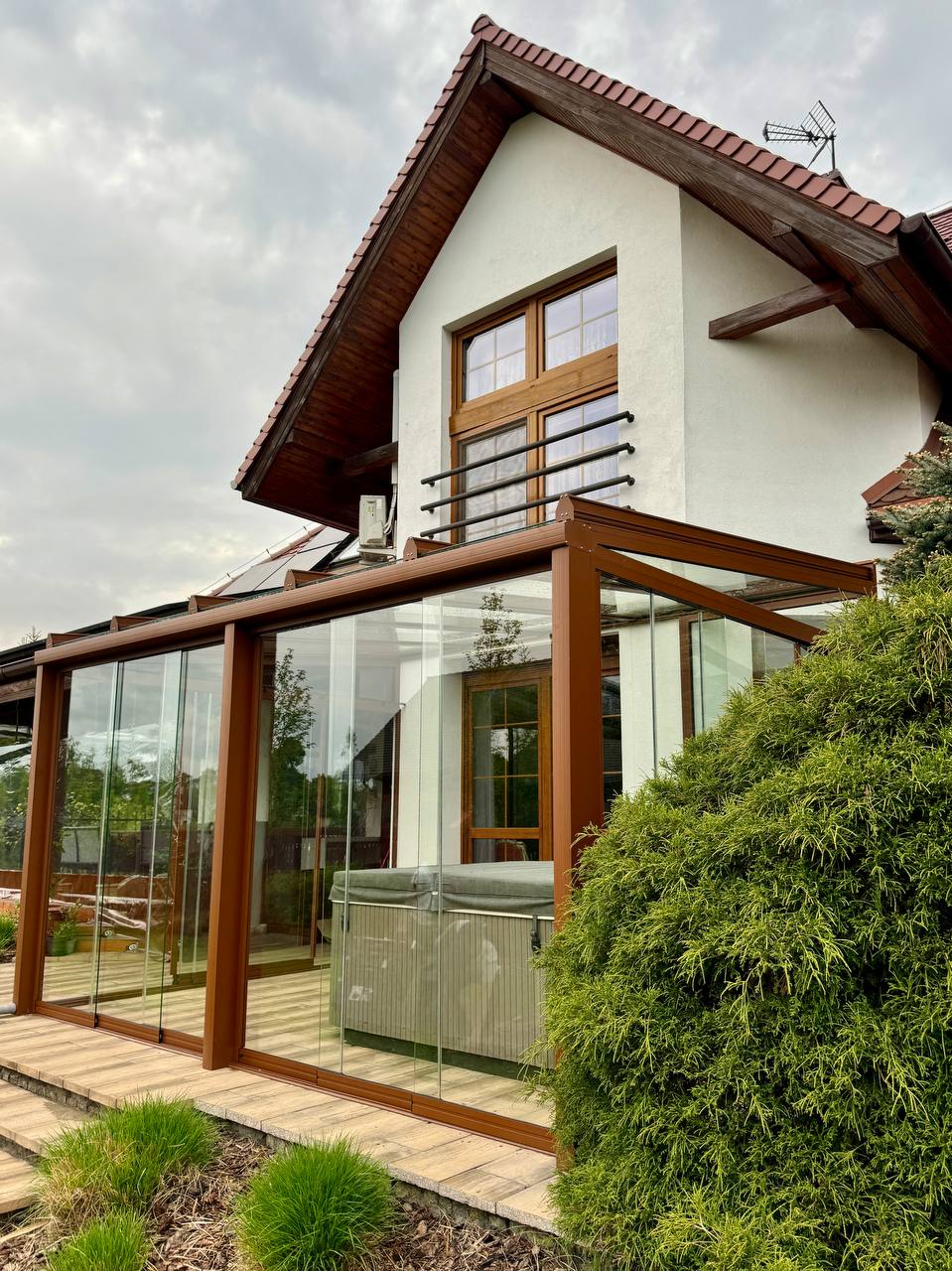
Do you dream of a winter garden that allows you to enjoy greenery all year round? Before you start construction, you need to know the answer to the question: does a winter garden require a permit? In this article, we explain what legal formalities must be met to build a winter garden, whether it is considered a building structure, how it affects property tax, and whether it can be added to a house. We will also answer questions such as: is a winter garden subject to tax? can a winter garden be built without notification? You will learn why it is worth trusting the experts from Steel Works, who will help you through the entire process – from design to legal compliance.
What is a winter garden under construction law?
Polish construction law does not provide a clear definition of a winter garden. Most often, it is a glazed structure used for relaxation, plant cultivation, or as an extension of living space. It can be freestanding or connected to a house, for example as an extension of a terrace. According to Article 29(1)(2) and Article 30(1)(1) of the Construction Law Act, the construction of “freestanding, single-storey utility buildings, including garages, gazebos, and home porches and conservatories (winter gardens) with a building footprint of up to 35 m², provided that the total number of such structures on a plot does not exceed two per every 500 m² of plot area,” does not require a building permit. As a lightweight, freestanding structure, it may be treated as a small architectural object, which simplifies formalities. Steel Works designs, manufactures, and installs custom-made winter gardens.
Read also: How much does it cost to build a winter garden?
Is a winter garden a building structure?
The question of whether a winter garden is a building structure is crucial for determining formal requirements. Under construction law (Article 3(2)), a winter garden is considered a building structure if it meets the criteria of a building: it is permanently attached to the ground and has walls, windows, and a roof. Freestanding winter gardens with an area of up to 35 m² may, however, be classified as small architectural structures, which exempts them from the need to obtain a building permit, but still requires notification. Larger structures or those that modify the structure of the house are treated as full-fledged buildings, which means more stringent requirements.
When does a winter garden require a building permit?
If a winter garden exceeds 35 m² or is added to the house in a way that alters its structure (e.g. requires reconstruction of load-bearing walls), a building permit is required. This also applies to winter gardens built on terraces or balconies, especially in multi-family buildings, where interference with the structure may require approval from the housing association or a permit.
Can a winter garden be built without notification?
Contrary to frequent questions about building a winter garden without notification, constructing a winter garden always requires at least notification to the authorities, even if a building permit is not required. Failure to submit a notification may result in the structure being classified as illegal construction, which can lead to a demolition order, legalization fees, or penalties. The notification includes basic information about the project, such as dimensions, materials, and location.
Can a winter garden be added to a house?
Yes, but the formalities depend on the method of extension. If the winter garden is an integral part of the house and alters its structure (e.g. requires new foundations or reconstruction of walls), a building permit is usually required. In the case of a lightweight structure, for example on an existing terrace, notification may be sufficient, provided that the area does not exceed 35 m². It is also worth checking the local zoning plan, which may impose restrictions regarding distances from plot boundaries, height, or sunlight access for neighboring properties.
Is a winter garden subject to property tax?
This depends on whether the winter garden is classified as a building. If it meets the criteria of a building (permanent attachment to the ground, walls, roof), it may be included in the usable floor area of the property and be subject to property tax. Tax rates are set by the municipal council and vary depending on location. Freestanding winter gardens up to 35 m² are often not included in the built-up area, which may reduce the tax burden, but to be sure, it is advisable to consult the local authority.
Important changes in construction law
In 2025, significant changes are being introduced in construction law, including those related to general municipal plans. This may affect the process of obtaining development conditions and permits. When planning a winter garden, it is worth consulting the local authority or a specialist to ensure that the investment meets all requirements.
How to notify the construction of a winter garden?
The process of notifying the construction of a winter garden includes several steps:
- Prepare a project description, including information about materials, dimensions, foundation method, and location.
- Check compliance with the local zoning plan, such as distance from plot boundaries.
- Submit the notification to the municipal office or county authority, attaching the required documents.
- Wait 30 days for any objection from the authority – lack of response means consent to proceed with construction.
Why choose Steel Works?
Building a winter garden requires knowledge of regulations. Steel Works designs and builds winter gardens using steel and glass, ensuring durability, aesthetics, and suitability to user needs. From design to installation, you can count on support with formal matters. Contact us to receive a quotation.
Summary
Small, freestanding winter gardens up to 35 m² usually require notification, while larger ones or those added to a house may require a building permit. A winter garden may be classified as a building structure, which affects formal requirements and potentially property tax. It is worth approaching the investment consciously and ensuring compliance with regulations.
Table of legal formalities for winter gardens
| Type of winter garden | Area | Formal requirements | Property tax |
|---|---|---|---|
| Freestanding, single-storey | Up to 35 m² | Notification | Usually not subject |
| Freestanding or attached | Above 35 m² | Building permit | Subject, if classified as a building |
| Attached to the house | Any | Permit required if structure is altered | Subject, if classified as a building |
| On a terrace/balcony | Any | Building permit, often housing association approval | Subject, if classified as a building |